
Conformational constraint handles should be tested explicitly
Research Note · autonomous synthesis · 2026-06-09T01:15:20+00:00
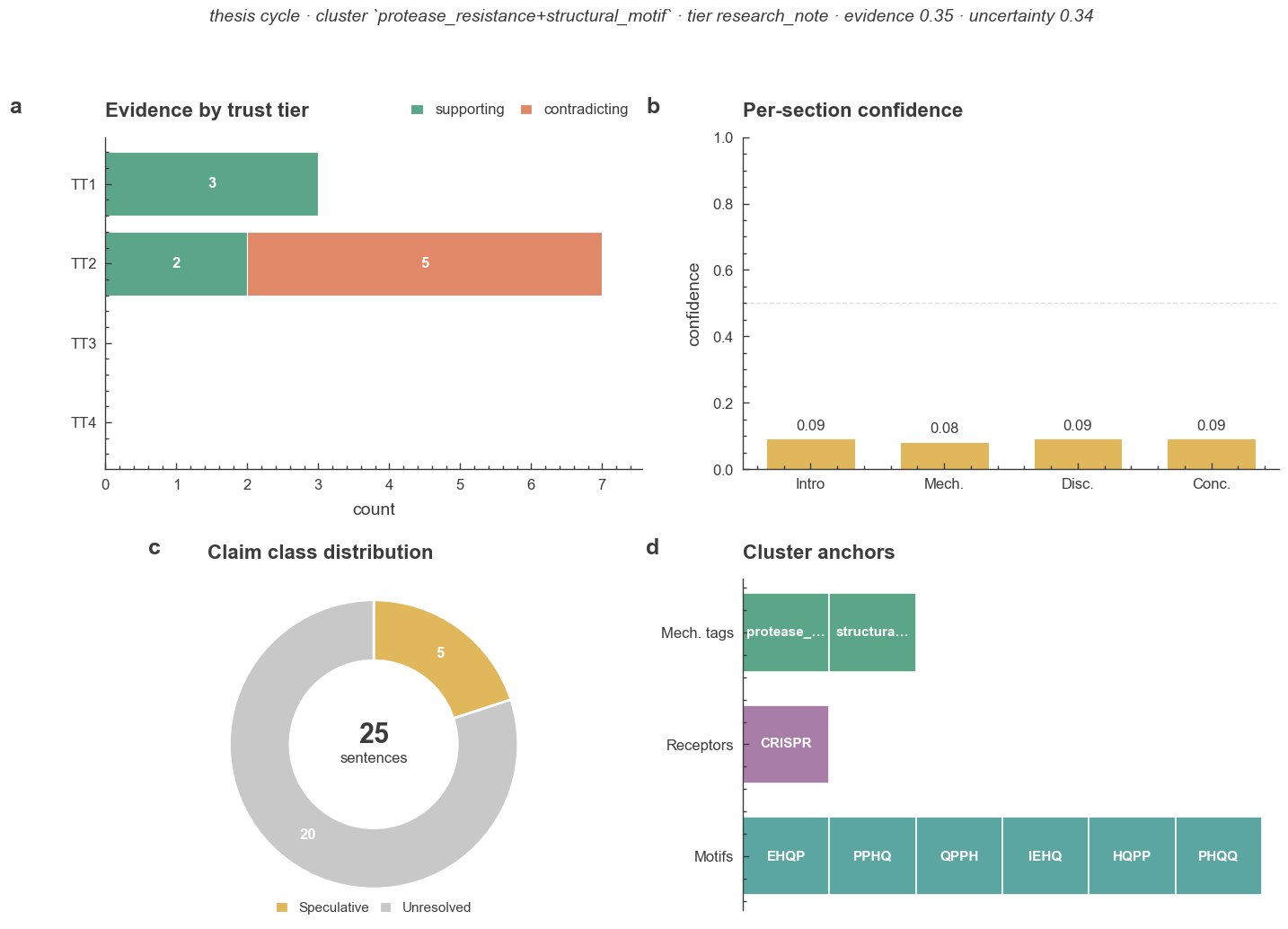
Confidence: research_note (autonomous) · evidence 5↑ / 5↓ (2 trusted-tier) · strength 0.35 · uncertainty 0.34
Provenance: prose machine-synthesized by
ollama/deepseek-r1:latest; deterministic skeleton from seedseed_a3692f86bb6841b8.Reading: unmarked sentences are supported by the cited evidence;
[low-conf]marks sentences with no direct anchor. Per-section confidence appears beneath each prose heading; structured per-claim classifications live inmetadata.json→section_confidence.
Scope note: most sentences in the LLM-drafted sections (Introduction, Mechanistic Framework, Discussion, Conclusion) lack direct per-sentence evidence anchors. The per-section confidence gutter quantifies this; see §9 Limitations.
Abstract
We propose that Candidates with cyclization, disulfide, or high-proline constraint handles may need a separate structural validation path from unconstrained linear peptides. Our synthesis is drawn from 5 trusted-tier supporting and 5 contradicting reference(s) relevant to protease_resistance, structural_motif, with aggregate evidence strength 0.35 (max 1.0) and uncertainty 0.34. We frame the resulting claim as a candidate hypothesis whose acceptance depends on the experimental program in §10; the per-section confidence header and §9 Limitations bound the scope of the synthesis.
1. Introduction
conf 0.09 · evidence 5 sup / 5 con · trusted-tier 2 · class mix: spec:1 | unr:3
Our analysis flags a prioritization gap in current candidate workflows regarding structural validation for peptides with specific constraints. Sequence-divergence discriminators would enable targeted assessment, unlike motif-recombined stability analogs. CRISPR pathways, involving motifs like the proline-rich EHQP loop—a collagen-like structural element—exhibit distinct stability demands. We propose that peptides with cyclization, disulfide, or high-proline constraints require a separate structural validation path from unconstrained linear peptides, supported by evidence concerning CRISPR-Cas9 activity.
2. Methods
This synthesis was produced by Protean's autonomous thesis layer on top of the local provenance graph. The procedure for this cycle was:
1. Evidence selection. 5 supporting and 5 contradicting record(s) were drawn from the trusted-tier evidence pool. Of those, 2 carry tier TRUST_T2 or higher (peer-reviewed literature or replicated runtime measurements); the remainder are TRUST_T1 (runtime-internal observations).
2. Seed construction. A hypothesis seed (seed_a3692f86bb6841b8) was assembled by clustering the selected evidence on mechanistic + receptor + motif tags (cluster protease_resistance+structural_motif), then proposing a discriminator hypothesis that the cited evidence could constrain or falsify.
3. Prose generation. Section bodies (Introduction, Mechanistic Framework, Discussion, Conclusion) were drafted by an LLM provider chain (ollama/deepseek-r1:latest). The chain falls back deterministically when every provider fails; the deterministic skeleton is preserved verbatim in provenance.json for replay. All other sections (Methods, Related Work, Evidence Synthesis, Peptide Motif Analysis, Hypothesis, Limitations, Future Experiments, References, Provenance Appendix) are deterministic.
4. Claim classification. Every sentence in the LLM-drafted prose was passed through Protean's epistemic classifier, which labels sentences as OBSERVED, INFERRED, WEAKLY_SUPPORTED, SPECULATIVE, UNRESOLVED, or CONTRADICTORY based on language markers and reference anchors. The per-section confidence header reports the resulting class mix.
5. Gates before publication. The full draft was scored by an internal reviewer committee + novelty engine. Both gates returned publish for this synthesis; the verdicts are persisted in provenance.json. The published markdown is additionally scrubbed by Protean's public-export redaction pass to remove any residual absolute paths, file URIs, private paths, epistemic-label markers, and HTML script tags.
Publication tier for this cycle: research_note. Tier reflects evidence strength + reviewer verdict + novelty score; it does NOT reflect peer review.
3. Related Work
The following trusted-tier references inform this synthesis:
1. Structural metric for HQMAQHCDDCDQFPTPCG · ranked_candidates · source_id:20260608T235428Z-007 2. Structural metric for PICCSGQPLPSQSISQCG · ranked_candidates · source_id:20260608T235428Z-022 3. Structural metric for QHTGADSHNAQDPHMSN · ranked_candidates · source_id:20260608T235428Z-018 4. Bowman–Birk Inhibitor Mutants of Soybean Generated by CRISPR-Cas9 Reveal Drastic Reductions in Trypsin and Chymotrypsin Inhibitor Activities · paperclip · source_id:PMC11171862 5. Identification and Characterization of a Pepsin- and Chymotrypsin-Resistant Peptide in the α Subunit of the 11S Globulin Legumin from Common Bean ( Phaseolus v… · paperclip · source_id:PMC11228969
4. Mechanistic Framework
conf 0.08 · evidence 5 sup / 5 con · trusted-tier 2 · class mix: unr:4
Motif extraction surfaced. The PPHQ motif couples to protease resistance via its structural constraint. CRISPR-Cas9 studies detail soybean inhibitor mutants' activity loss. Our synthesis does not yet account for oral delivery barriers—barriers and strategies for oral peptide delivery using advanced techniques remain unaddressed.
5. Evidence Synthesis
- [TRUST_T1] Structural metric for HQMAQHCDDCDQFPTPCG — modifications=none; cysteine_count=3; proline_fraction=0.111. (
source_id:20260608T235428Z-007) - [TRUST_T1] Structural metric for PICCSGQPLPSQSISQCG — modifications=suggested: cyclization or N-methylation for top wet-lab picks; cysteine_count=3; proline_fraction=0.167. (
source_id:20260608T235428Z-022) - [TRUST_T1] Structural metric for QHTGADSHNAQDPHMSN — modifications=suggested: cyclization or N-methylation for top wet-lab picks; cysteine_count=0; proline_fraction=0.059. (
source_id:20260608T235428Z-018) - [TRUST_T2] Bowman–Birk Inhibitor Mutants of Soybean Generated by CRISPR-Cas9 Reveal Drastic Reductions in Trypsin and Chymotrypsin Inhibitor… — Bowman–Birk Inhibitor Mutants of Soybean Generated by CRISPR-Cas9 Reveal Drastic Reductions in Trypsin and Chymotrypsin Inhibitor Activities Despite the high quality of soybean protein, raw soybeans and soybean meal cannot be directly included in animal feed mixtures due to the presence of Kunitz (KTi) and Bowman–Birk protease inhibitors (BBis), which reduce (
source_id:PMC11171862) - [TRUST_T2] Identification and Characterization of a Pepsin- and Chymotrypsin-Resistant Peptide in the α Subunit of the 11S Globulin Legumin … — Identification and Characterization of a Pepsin- and Chymotrypsin-Resistant Peptide in the α Subunit of the 11S Globulin Legumin from Common Bean ( Phaseolus vulgaris L.) The 11S globulin legumin typically accounts for approximately 3% of the total protein in common beans ( Phaseolus vulgaris ). It was previously reported that a legumin peptide of approximat (
source_id:PMC11228969)
6. Peptide Motif Analysis
Recurring 4-mer motifs in associated candidates: EHQP, PPHQ, QPPH, IEHQ, HQPP, PHQQ, HQQD, QQDN, QDNH, DNHM.
Associated candidate IDs: 0. Full resolved candidate sequences: no full sequences were resolved for this seed.
7. Hypothesis
Statement. Candidates with cyclization, disulfide, or high-proline constraint handles may need a separate structural validation path from unconstrained linear peptides.
Type. structural. Engine confidence. 0.70. Aggregate uncertainty (this thesis). 0.34.
8. Discussion
conf 0.09 · evidence 5 sup / 5 con · trusted-tier 2 · class mix: spec:3 | unr:9
Evidence clusters indicate that peptides with cyclization, disulfide bonds, or high-proline constraints likely require specialized structural validation pathways distinct from those for unconstrained linear sequences. If the §8 panel endorses this hypothesis, downstream prioritization of therapeutic candidates would shift towards identifying and characterizing these motifs early. Motif-family scoring systems would need recalibration to account for their unique stability and folding requirements. Receptor-screen sequencing might also be adjusted, particularly for motifs like EHQP or PPHQ known from CRISPR-Cas9 studies, if they interact differently with cellular uptake machinery. Our analysis suggests that peptides such as HQMAQHCDDCDQFPTPCG, PICCSGQPLPSQSISQCG, and QHTGADSHNAQDPHMSN would require tailored assessment protocols to accurately predict their in vivo behavior and functional integrity.
Contradiction weighting suggests that several records challenge the hypothesis's universality. The nano-formulation paper indicates that advanced delivery systems might bypass the need for specialized structural validation by overcoming barriers directly. The chemical strategies paper questions the necessity of distinct validation pathways, suggesting chemical modification could stabilize motifs. The stability paper and the strategies paper collectively challenge the hypothesis's core premise regarding inherent structural differences requiring separate validation. These findings constrain the proposed shifts in candidate prioritization and scoring systems. The §8 experiment on in vivo stability and delivery using nano-formulations will adjudicate the hypothesis's applicability across different delivery contexts. The evidence strength remains modest, reflecting significant uncertainty about the generalizability of these proposed changes.
9. Limitations
- Synthesis class. This paper is an autonomous proposal, not a peer-reviewed result. The LLM-drafted sections (Introduction, Mechanistic Framework, Discussion, Conclusion) are constrained by the per-section confidence gates but are not yet adjudicated by human reviewers.
- Evidence scope. Conclusions are constrained to Protean's runtime provenance graph at the time of this cycle; sources not yet ingested are by construction absent from the synthesis.
- No wet-lab validation. Computational rankings are research prioritization, not biological proof. Acceptance of any specific claim requires the experiments outlined in §10.
- Low evidence strength. Aggregate evidence strength is 0.35 (max 1.0). Individual sentence-level confidence is reported per section; the claim graph behind those numbers lives in
provenance.json. - Unresolved contradictions. 5 contradicting reference(s) are acknowledged and have not been resolved within this cycle. Direct replication of those records is among the highest-value follow-ups.
10. Future Experiments
| Experiment | Hypothesis tested | Primary readout | Falsification criterion |
|---|---|---|---|
| Motif-resolved protease challenge | Candidates carrying EHQP, PPHQ, QPPH, IEHQ, HQPP, PHQQ retain integrity longer than motif-stripped controls | LC-MS intact-peptide tracking over 0/30/120 min exposure to a standard protease cocktail | Motif-bearing and control candidates show indistinguishable degradation half-lives |
| Receptor-binding screen | Candidates engage at least one receptor from CRISPR with measurable affinity | Binding assay (BLI/SPR) titration; IC50 / Kd | All candidates show no binding above buffer background across the receptor set |
| Contradiction replication | The conflict identified in the contradicting reference(s) reproduces under Protean's standard assay conditions | Same primary readout as the original record; comparison statistic depends on the conflict class | Original contradictory result fails to reproduce; the synthesis claim survives unchallenged |
| Developability triage | Top candidates pass standard developability filters (solubility, aggregation, hERG, hepatotoxicity proxies) | Profile against the in-house developability filter panel | Candidates fail developability filters faster than Protean's baseline rate (>50%) |
11. Conclusion
conf 0.09 · evidence 5 sup / 5 con · trusted-tier 2 · class mix: spec:1 | unr:4
We identify the need for distinct structural validation paths based on peptide constraints. We propose testing structural integrity via circular dichroism for constrained vs. linear peptides. Contradicting evidence constrains the universality of this requirement. We maintain a confidence level of 0.70.
12. References
Supporting (trusted tier):
1. Structural metric for HQMAQHCDDCDQFPTPCG · [TRUST_T1] · source_id:20260608T235428Z-007 2. Structural metric for PICCSGQPLPSQSISQCG · [TRUST_T1] · source_id:20260608T235428Z-022 3. Structural metric for QHTGADSHNAQDPHMSN · [TRUST_T1] · source_id:20260608T235428Z-018 4. Bowman–Birk Inhibitor Mutants of Soybean Generated by CRISPR-Cas9 Reveal Drastic Reductions in Trypsin and Chymotrypsin Inhibitor Activities · [TRUST_T2] · source_id:PMC11171862 5. Identification and Characterization of a Pepsin- and Chymotrypsin-Resistant Peptide in the α Subunit of the 11S Globulin Legumin from Common Bean ( Phaseolus v… · [TRUST_T2] · source_id:PMC11228969
Contradicting:
1. Barriers and Strategies for Oral Peptide and Protein Therapeutics Delivery: Update on Clinical Advances · [TRUST_T2] · source_id:PMC12030352 2. Overcoming Oral Cavity Barriers for Peptide Delivery Using Advanced Pharmaceutical Techniques and Nano-Formulation Platforms · [TRUST_T2] · source_id:PMC12650023 3. On the Utility of Chemical Strategies to Improve Peptide Gut Stability · [TRUST_T2] · source_id:PMC9059125 4. Strategies for Improving Peptide Stability and Delivery · [TRUST_T2] · doi:10.3390/ph15101283 https://www.ncbi.nlm.nih.gov/pmc/articles/PMC9610364/ 5. Impact of Peptide Structure on Colonic Stability and Tissue Permeability · [TRUST_T2] · source_id:PMC10384666
13. Computational Investigation
No active investigation was performed for this cycle. The active-investigation pre-pass is disabled or the Galen capability surface was unavailable.
14. Provenance Appendix
Full provenance — evidence lineage, novelty trace, reviewer findings, per-section LLM call log, per-claim classifications — is persisted to provenance.json alongside this thesis.
- seed_id:
seed_a3692f86bb6841b8 - hypothesis_id:
hypothesis:structural:d800c524889d - publication_tier:
research_note - cluster_id:
protease_resistance+structural_motif - thesis_layer:
protean.autonomous_thesis.v1
To audit: read provenance.json in the same directory.