
Galen · Protean's scientific agent layer
The physician
inside the machine.
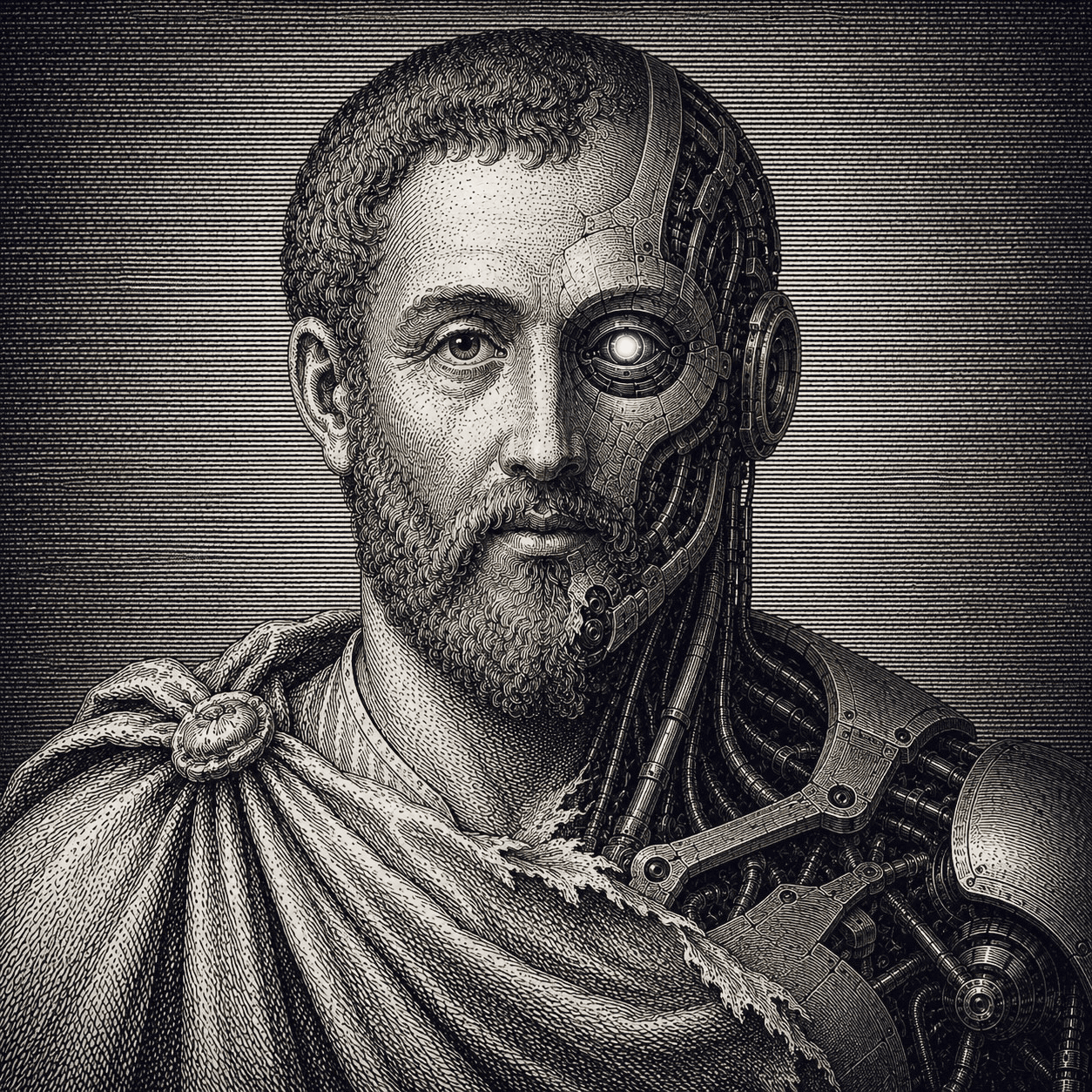
Galen — half classical physician, half machine intelligence.
An ancient name for a new scientific agent. Trained on Protean's scientific memory, Galen audits the runtime, challenges hypotheses, watches provenance, and helps turn autonomous peptide discovery into review-ready science.
- Ancient medicine. Modern memory.
- Protean discovers. Galen remembers.
- Models propose. Galen interrogates. Validators decide.
01—Who was Galen
A physician's name,
rebuilt for science.
Galen of Pergamon was one of the most influential physicians in history. His system of observation, anatomy, and recorded evidence shaped scientific thought for nearly fifteen centuries. We take the name as a small commitment — that reasoning over biology must be systematic, observed, and recorded. Two millennia later, the same discipline is rebuilt as an agent, at machine scale.
Galen is not a chatbot, an assistant, or an LLM wrapper. He is the reasoning layer around Protean's scientific operating system — the agent that reads the runtime.
02—Scientific memory
Trained on Protean's
scientific memory.
Galen is grounded in the memory Protean accumulates as it works — runtime context, provenance records, candidate history, hypotheses, failures, and research artifacts. He reads that memory to turn raw autonomous discovery into inspectable scientific work. Every candidate has a memory. Every hypothesis has a trail.
Runtime context
The live discovery runtime — cycle state, health, and capability — read continuously rather than from a snapshot.
Provenance records
The lineage graph: where every candidate, signal, and claim came from, and the content hashes that anchor it.
Candidate history & lineage
Survivor parents, frontier candidates, rejected regions, and the families that connect them across cycles.
Hypotheses & contradictions
Open scientific questions and the contradiction graph that keeps them honest against prior evidence.
Failure memory
The rejection record — so old dead-ends are remembered and read forward, not silently repeated.
Research artifacts & evidence
Evidence bundles, proteomics summaries, structural references, and the recorded work of past cycles.
03—What Galen does
The agent that
reads the runtime.
Galen reads the runtime, audits evidence, reviews hypotheses, watches provenance, examines candidate context, surfaces weak points, and prepares review-ready scientific reasoning — eight bounded kinds of work, every one of them inspectable.
01
Runtime audit
Reads the live runtime — cycles, health, and capability state — and surfaces what changed and what needs a closer look.
02
Candidate review
Examines candidate context, lineage, and the scoring surface, and flags weak points before they reach a person.
03
Evidence & provenance checks
Walks the provenance graph and evidence bundles, checking that every claim carries a recorded, reproducible trail.
04
Hypothesis critique
Challenges hypotheses against prior cycles, contradictions, and the failure record — not to confirm them, to interrogate them.
05
Failure-memory interpretation
Reads the rejection and failure memory so the runtime learns from what did not work instead of forgetting it.
06
Research-plan generation
Drafts review-ready scientific reasoning and next-step plans, grounded in what the runtime already knows.
07
Review-gated publication support
Prepares public-safe, provenance-carrying drafts for human review. No auto-submit, no validation claim, no biological proof.
08
Operator handoff
Bundles review-ready work and its full lineage so an operator can inspect it, decide, and act.
Galen is not the final authority. Deterministic validators, provenance gates, review gates, and human scientific review remain authoritative.
04—The runtime contract
Models propose.
Humans review.
Galen sits inside a strict chain of authority. He reasons over the science — he does not decide it. Nothing Galen produces submits a wet-lab order, spends funds, publishes on-chain, mutates a score, or bypasses review.
Models propose.
Generative and scoring models put candidates and signals forward.
Galen reasons.
Reads the memory, audits the evidence, and interrogates the proposal — and writes no authoritative scientific truth.
Validators check.
Deterministic validators and provenance gates decide what is admissible.
Provenance records.
Every output carries a content hash and a lineage record.
Humans review.
Wet-lab validation and human scientific review remain the authoritative layer.
Computational rankings are research prioritization signals. They do not prove biological activity, therapeutic effect, safety, efficacy, or experimental validation. Wet-lab validation and human scientific review remain the authoritative downstream layer.
05—Coming to X soon
A public research
agent, being prepared.
Galen is coming to X (Twitter) soon — a public research agent trained on Protean's scientific memory and runtime context. It is being prepared now, and will surface public-facing scientific reasoning: runtime reads, candidate context, and the questions Galen is asking. Review-gated, provenance-aware, and never a claim of proven biology.
Status · being prepared · public reasoning to follow
Protean discovers · Galen remembers